
In the heart of Tribeca stands Maxwell Social – a private members’ club built around the joy of cooking and gathering. Founded by David Litwak, Joelle Fuchs & Kyle Chaning-Pearce, Maxwell reimagines what a modern social space can be: a place where conversation flows as freely as the wine, and where the kitchen takes center stage.
When designing Maxwell’s richly layered interiors, the team sought details that felt as authentic as the community they were creating. Ruffoni became a huge part of Maxwell’s story and brought warmth, heritage, and artistry into every corner of Maxwell.
We sat down with David for a conversation about the art of gathering and how Ruffoni’s craftsmanship became woven into the soul of Maxwell.

Maxwell’s kitchens are built for gathering — and the glowing Ruffoni is the perfect conversation starter.
R: Tell us about Maxwell and what’s unique about it.
D: Unlike other private members' clubs, Maxwell is built for a small, intimate community. We have kitchens you can cook in (in Ruffoni's pots and pans of course!) and we seek to create an environment more akin to a shared living room than a restaurant or club.
We have modeled the membership after a lot of true communities. One of the coolest ones is a Txoko. These are little eating clubs that originated in San Sebastian, but have spread all around Spain as well. They are often only a few hundred members and their memberships are passed down through generations, and these members often spend a lot of time cooking with each other in communal kitchens.
So the center of Maxwell is built around the kitchen. We have three beautifully designed kitchens where Ruffoni’s copper pots and pans are in residence, and we use them to cook together as a club. We also invite amazing private chefs to create special dinners, and many celebrities have cooked here as well — including Blake Lively, who used the space for the launch of her alcohol brand, Betty Booze.
At our core, we're a membership club with kitchens at the center For their living spaces, Maxwell selected pieces from the Historia and Opus Cupra collections.
R: Many young entrepreneurs are doing tech - why did you decide to rent and renovate a giant space in Tribeca and open a club for people to get together and socialize?
D: I think there's a huge loneliness epidemic happening right now. We have gutted many of the traditional institutions that led to community. Churches, synagogues, and mosques are no longer relevant to the day-to-day lives of many urban dwellers.
We used to have an entire tier of what were essentially adult fraternities, the Rotarians, Kiwanis, Elks, Moose, American Legion, Knights of Columbus, you name it. There was a social club on every corner 50, 60 years ago. For kind of obvious reasons, as many of these were segregated on race and sex – the Italian American Men's Club, for example – they are no longer relevant.
So I'm fascinated by the idea of how do you create a space and a new structure and business model to allow people to get together and socialize in a way that is sustainable for our generation.

At Maxwell, Ruffoni Historia and Opus Cupra shine on the table, from special events to midweek dinners.
R: Compared to other members' clubs, the aesthetic at Maxwell is much more maximalist and distinct, with a strong emphasis on kitchens (and pretty cookware, if we may say so) – why?
D: Maximalist aesthetics are back in fashion! We had a huge surge of a minimalist kind of White Hampton's look, Scandinavian minimalism over the past 20 years, monochromatic and clean lines styling. And I think that ultimately, people want color, people want patterns, people want a level of vibrancy that is returning to design. And we think Maxwell's on the forefront of that. So that's a personal preference as to why we designed it this way.
As to why kitchens — everyone ends up in the kitchen at a house party. Kitchens are this communal spot. There's also something about a kitchen that communicates contribution as well. You're in it, you're equals. You're potentially participating. You're chopping the zucchini right alongside whoever else is preparing dinner. That's a really core part of our culture, participation.
We want a participatory culture. We require members to actually put effort into joining this club. They have to attend a minimum of five events in the first three months. They go through a cohort program.
If they don't attend those events, they get kicked out. We require contributions from our members in order to be a member here, aside from just financial. And we feel the kitchen kind of symbolizes that.
We also feel the kitchen symbolizes a different type of luxury. One of service instead of access. No one thinks of you as slumming it if you're staying in an Airbnb and cooking your own eggs, especially if the Airbnb is a chateau in France. So we think hospitality is often defined as increasing levels of service. How can I take every possible thing off your plate that you don't have to do anything. But we view hospitality as an opportunity to participate in a beautiful space, and a kitchen symbolizes that.
A row of well-used, patinated Ruffoni Historia and Opus Cupra pieces adds authenticity to the space.
R: What made you approach Ruffoni, and what do you think we bring – literally –to the table?
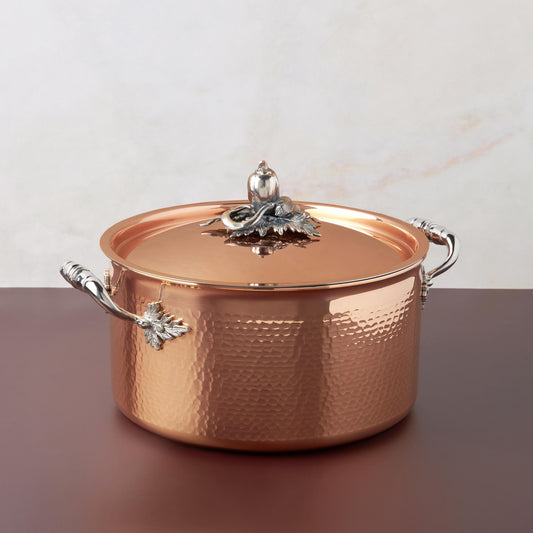
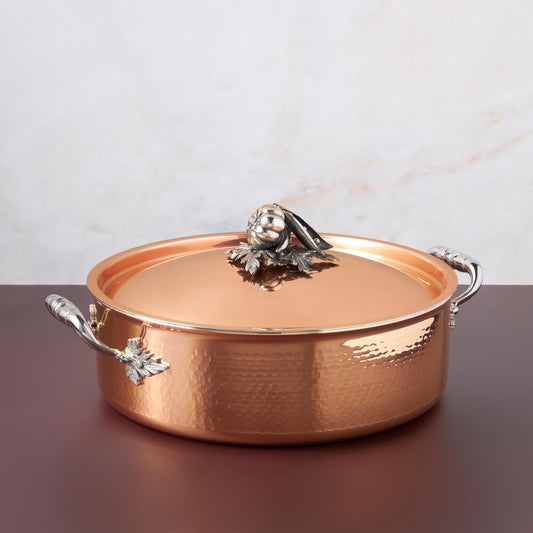
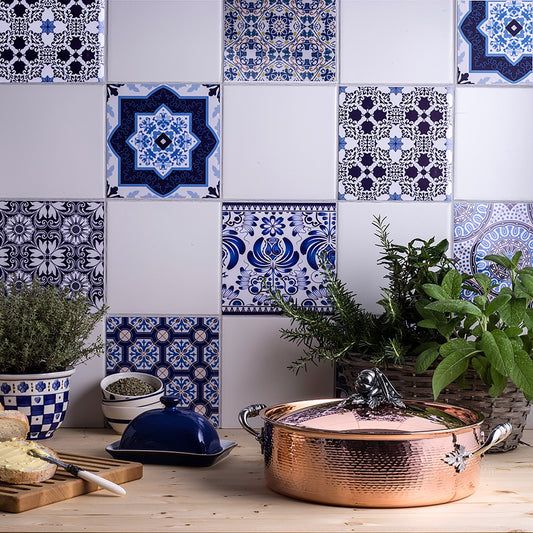
There's an old school grandeur to Ruffoni's products, the handmade nature, the materials, the real copper. We took great pains at Maxwell to never have anything fake. Every stone is real. Every piece of copper can patina. There is no brass-plated aluminum. Everything is real. And Ruffoni to us represented a very real sense of true cooking, true craftsmanship in the kitchen.
R: Ok, now we’re curious. What do members and guests say when they first see the cookware – and then when they cook with it?
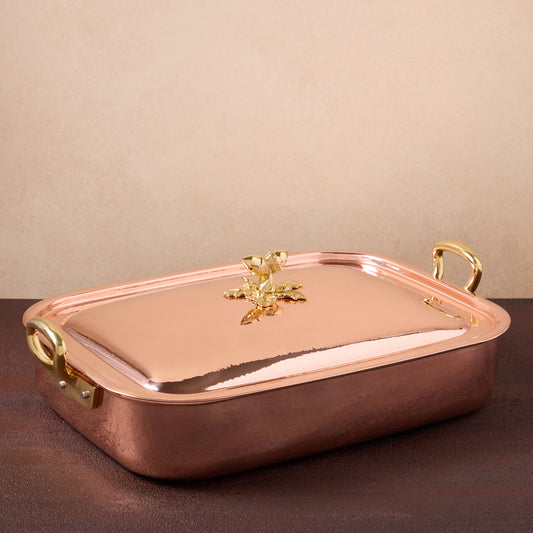
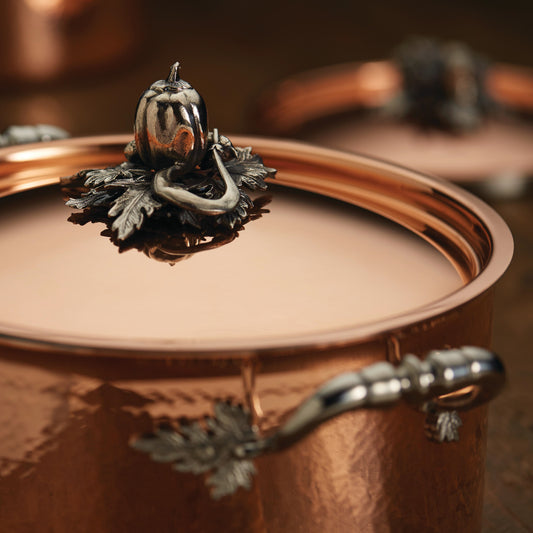
Well, the first thing is they remark on how beautiful it is, the ornamentation. We love the ornamentation so much that we actually asked you guys to send us a bunch more of your handles and acorn knobs because we felt we could use them in other places.
And the acorn knobs are now used as coat racks in various spots. And the handles have been incorporated into our kitchens as well.
So we are probably the only kitchens in the world with actual Ruffoni handles on our cabinets, and people are constantly commenting on how beautiful they are. And of course, they’re practical as well. Just like your pots and pans, it’s both form and function — beautiful aesthetics paired with the ability to cook a wonderful meal.
Maxwell’s team loved Ruffoni’s decorative details so much, they reused them throughout the rooms — a unique touch found only at Maxwell.
R: What's your favorite Ruffoni piece?
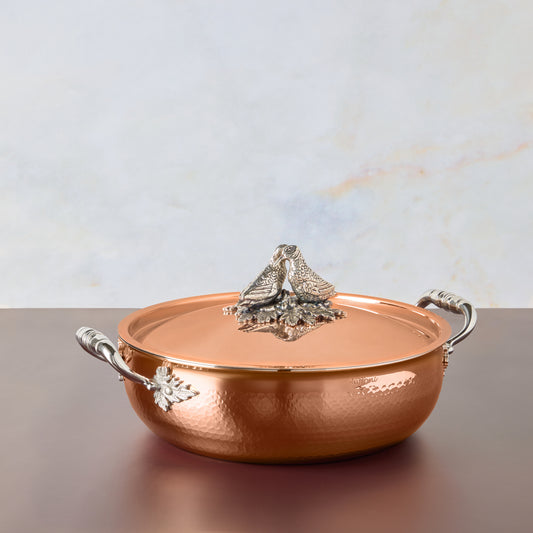
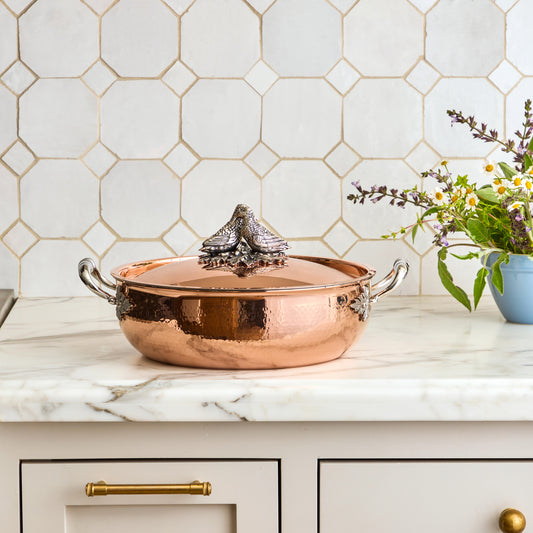
D: There’s some really ornate copperware with a pumpkin and harvest-themed symbol as the handle. I love the ornate handles – the creativity, the whimsical nature of them. I adore that kind of old-school artistry. I know that Ruffoni hand-carved the molds for those handles and that a lot of effort went into making a “simple” handle. It’s so beautiful, and I truly adore it.
R: What's your favorite meal you cooked in Ruffoni?
D. On a weekly basis, we hire a private chef to cook breakfast for our members. And so every Friday, there's a chef who cooks a very simple pancake and egg breakfast that any member can come have and bring as many friends as they want. And then sometimes on Saturdays and Sundays, I like to come watch a Premier League football match at Maxwell, often with just a few other member friends on slow hours, and I'll cook some pancakes myself, and I love cooking pancakes with Ruffoni cookware.

Three kitchens, three different moods. Every space at Maxwell is designed to inspire and foster community and exchange.
R: What's your favorite dinner party memory hosted at Maxwell?
D: Once a month, we do something called a family dinner, where members cook for other members. It's a big tradition of ours, and it's one of our rituals. It really forces people to kind of get their hands dirty.
It's also a really great way for people to meet each other. You're not coming to a dinner party and just awkwardly sitting next to someone, you have an opportunity to say, how can I help? What can I chop? Can I cook something? And it's a really great way to kind of break the ice.
And Ruffoni has enabled us to really build that kind of communal culture at Maxwell.
R: Thank you so much for your words, David, and for opening Maxwell’s doors to Ruffoni. We can’t wait to join you for a risotto night the next time we’re in town!
|
Maxwell is a private social club in Tribeca, New York City, built entirely around the kitchen. Inspired by historic communal spaces and traditions of shared cooking, it was designed as a place where gathering happens naturally around food. With fully open kitchens stocked with Ruffoni copper and a culture that invites members to cook and eat together, Maxwell has become a true hub of community – and a go-to spot for celebrities such as Blake Lively, Anna Wintour, and Kate Hudson, as well as brands like CAA and Manchester City Football Group. Discover more • Follow Maxwell on Instagram |